Inteligencia artificial (IA)

Litigios relacionados con IA física

J.S. Held adquiere Element Forensic Engineering, ampliando así sus capacidades especializadas en seguros para reclamos de daños a la propiedad en el segmento de empresas medianas y de grandes en todo Canadá

LEER MÁS cerrar Creado con Sketch.

AI may operate behind the scenes, but its failures can cause real-world injury and damage. Physical AI losses raise engineering, coverage, human factors, and damages questions - and J.S. Held answers all four.

AI risk is often considered a software problem: an issue of copyright, training data, trade secrets, algorithmic bias, and hallucination. The losses are perceived as purely economic and the disputes contractual.

However, the risk profile has evolved beyond software AI disputes to include physical losses where AI is embedded in machines that move, lift, drive, cut, inspect, and operate alongside people. Machines such as industrial robots, warehouse automation, autonomous vehicles, commercial drones, autonomous heavy and agricultural equipment, surgical and caregiving robotics, and AI-controlled building and process infrastructure.

When physical AI systems fail, they can produce an injury, fire, property loss, product recall, a regulatory investigation, or an insurance claim.

Addressing these losses requires an integrated view of the physical event, the machine and model evidence, the human interaction, and the resulting financial impact.

J.S. Held combines these disciplines to help insurance claims professionals and legal counsel determine:

  • What happened
  • Why it happened
  • What the impacts were
  • Who is responsible
  • How the loss should be measured

We bring our deep, courtroom-tested technical and financial expertise – built over decades – to a new class of claims and disputes.

Four Quadrants. One Firm.

/uploads/Axes.jpg

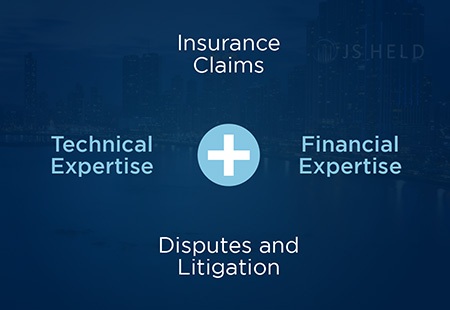
J.S. Held is a global consulting firm organized across two axes: financial and technical expertise, applied to insurance claims and complex disputes.

These four quadrants share a single underlying competency: determining the value and consequence of an event under a governing document. In litigation that document is a contract, a patent, or a statute. In insurance it is a policy. The analytical discipline is the same. Only the instrument changes.

A physical AI loss lands in all four quadrants at once.

The Next Generation of a Market J.S. Held Already Leads

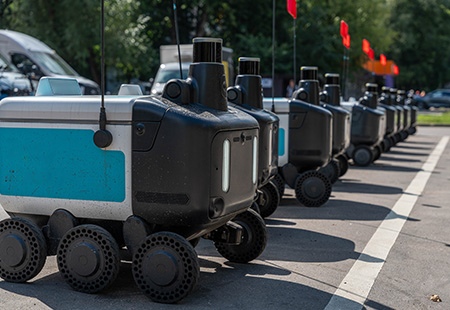
/uploads/AI-Delivery-Robot.jpg

J.S. Held identified the first generation of AI disputes early, published a framework, built an index, and now serves as damages expert in matters that are helping shape how AI losses are valued.

Physical AI is the second generation of that same market — more deeply connected to the core capabilities J.S. Held delivers. Every significant autonomous-system failure generates a chain of technical, operational, insurance, human-factors, economic, regulatory, and litigation issues that align with the multidisciplinary model our firm has spent decades building.

J.S. Held Physical AI Dispute Services

Forensic Engineering and Failure Analysis

Cause and origin; materials and component analysis; laboratory examination; fire, thermal-runaway, and energy-storage events; structural, electrical, and mechanical failure in automated environments.

Factores humanos

Human-robot interaction and reasonable reliance; automation bias and over-reliance on automated systems; warning and interface adequacy for machines with model-driven behavior; safety-control bypass and foreseeability; shared-workspace design.

Reconstrucción de accidentes

Autonomous and driver-assisted vehicle collision; delivery robot, drone, and autonomous forklift incidents; mining and agricultural machinery; premises liability; integration of physical evidence with perception and control data into a demonstrable sequence.

Consultoría de equipos

Robot and automation failure analysis; sensor, actuator, drive, and battery failure modes; industrial, warehouse, port, mining, and agricultural systems; valuation and condition assessment; repair-versus-replace determination for autonomous systems, including retraining, recalibration, and revalidation cost.

Digital Investigations and Cyber

Preservation, extraction, and authentication of sensor logs, video, perception outputs, decision records, model prompts and outputs, and telemetry; operational-technology and industrial-control-system forensics; autonomous-agent incident investigation; chain of custody for machine and model evidence. Determining what the machine knew, when it knew it, and why it acted.

Economic Damages and Forensic Accounting

Bodily injury and wrongful-death economics; life-care planning; business interruption and contingent business interruption; lost profits; recall and withdrawal cost; subrogation support.

Propiedad intelectual

Patent and trade-secret damages across robotics, autonomous navigation, sensor fusion, perception, edge-AI silicon, battery technology, and human-machine interfaces; licensing and FRAND; ITC matters; valuation of AI-enabled machinery, training data, and model assets; model provenance and derivation analysis.

Construcción

Autonomous survey drones, AI equipment monitoring, autonomous machinery, robotic fabrication, and AI scheduling; delay and productivity claims; defective execution; safety incidents; allocation where a schedule or sequence was generated by a model.

Medioambiente, salud y seguridad

Workplace safety; autonomous hazardous-material handling; chemical and process-plant automation; mining automation; OSHA investigation and response; root-cause analysis; safety program design; regulatory compliance.

Corporate Investigations, Risk, and Compliance

Autonomous Systems Risk Review — board-level assessment of deployment safety, liability allocation, control environment, and incident-response readiness; AI-governance frameworks for physical systems; disclosure and AI-claim substantiation review.

Para obtener información adicional sobre nuestros servicios y para ponerse en contacto con el experto indicado de nuestro equipo global, comuníquese con:

James E. Malackowski
Ver biografía
James E. Malackowski
Director de propiedad intelectual | Líder de la práctica de Propiedad Intelectual
Scott Armstrong
Ver biografía
Scott Armstrong
Vicepresidente ejecutivo | Líder de práctica de equipos
Mark Cohen
Ver biografía
Mark Cohen
Director ejecutivo sénior| Líder de la práctica de Servicios Globales de Asesoría en Construcción
Stephen Fenton
Ver biografía
Stephen Fenton
Vicepresidente ejecutivo | Líder de la práctica de Reconstrucción de Accidentes
Rob Goodwin
Ver biografía
Rob Goodwin
Vicepresidente ejecutivo | Líder de Práctica en Arquitectura e Ingeniería Forense
John Peiserich
Ver biografía
John Peiserich
Vicepresidenta ejecutiva | Líder de prácticas de medioambiente, salud y seguridad
Andrew Ross
Ver biografía
Andrew Ross
Vicepresidente ejecutivo | Líder de la práctica de consultoría de la construcción
Richard Sexton
Ver biografía
Richard Sexton
Vicepresidente ejecutivo | Líder de práctica de fianza
Aubrey Shea
Ver biografía
Aubrey Shea
Vicepresidente ejecutiva | Directora de la oficina de contabilidad forense y servicios de seguros
Katie Twomey
Ver biografía
Katie Twomey
Directora general ejecutiva | Directora de la práctica de Riesgo del Constructor (CAR/EAR)
David Weiner
Ver biografía
David Weiner
Vicepresidente ejecutivo | Director de la práctica de Valuaciones y Daños Económicos
Robert Rauschenberger
Ver biografía
Robert Rauschenberger
Vicepresidente | Director de Factores Humanos
JP Brennan
Ver biografía
JP Brennan
Director ejecutivo sénior, Tecnologías Avanzadas
Mike Gaudet
Ver biografía
Mike Gaudet
Director ejecutivo sénior de descubrimiento e investigaciones digitales

Preguntas frecuentes

What makes disputes involving physical AI unique?

Physical AI systems record what they do, producing an evidentiary record before anyone knows there will be a dispute. Every autonomous machine continuously logs sensor inputs, perception outputs, planning decisions, actuator commands, software and model versions, and operator interactions.

  • They sense: capturing real-time data
  • They understand: analyzing sensor data and spatial environments, while simulating physical laws, object behaviors, and future actions
  • They act: triggering intelligent actions

Physical AI may be the first category in which the machine itself holds the answer — if it is preserved, extracted, and authenticated before it is overwritten.

What changes between software AI and physical AI disputes?

The Loss

  • Software AI: economic and reputational
  • Physical AI: bodily injury, property damage, business interruption

The Evidence

  • Software AI: documents, model outputs, training data
  • Physical AI: the machine itself, plus continuous sensor and decision telemetry

Who Pays

  • Software AI: litigants
  • Physical AI: insurance companies and then litigants

Who Investigates

  • Software AI: counsel; technical consultants; and intellectual property, economics, and data science consultants
  • Physical AI: engineering, human factors, forensics, claims, economics, and intellectual property consultants

What uniquely positions J.S. Held to address physical AI disputes?

Physical AI losses do not fit within a single discipline. They can involve engineering failure, human interaction, digital evidence, insurance claims, economic damages, and litigation. J.S. Held brings technical and financial expertise across insurance claims and complex disputes, enabling our experts to examine the event and its consequences through a coordinated, multidisciplinary approach.

What is J.S. Held’s response protocol for physical AI incidents?

Our intake protocol specifies scene and machine preservation, the digital evidence to be captured before it is overwritten, chain of custody for model artifacts and telemetry, the sequence in which disciplines engage, and a single point of contact for the client. One call, one team, one accountable party.

How can investigators determine why an autonomous system acted the way it did?

Investigators can reconstruct an autonomous system's actions by connecting physical evidence with its perception, planning, control, and operator-interaction data. This may involve examining what the system sensed, how it interpreted its environment, what decision it made, which actuator commands followed, and whether an operator intervened. The objective is to establish what the machine knew, when it knew it, and why it acted.

What are examples of physical AI losses across insurance lines?

Commercial general liability
Robot strike and crush injury; public-interaction failure; autonomous delivery incident; premises exposure in automated facilities

Propiedad
Robot-caused fire; battery and energy-storage thermal events; AI-controlled building and process-system failure

Product liability
Design, manufacturing, and software defect; sensor and perception failure; inadequate warning and interface design

Professional and E&O
Erroneous automated recommendation; medical and surgical robotics; AI-assisted engineering and design

Auto and fleet
Autonomous and driver-assisted vehicle collision; platooning and yard-automation incidents

Cibernético
Compromise of operational technology and control systems producing physical consequence

Workers’ compensation and EHS
Injury in shared human-robot workspaces; OSHA action and root cause

Recall and product withdrawal
Fleet grounding; software recall; regulatory withdrawal
¿Aún tiene preguntas?

Contáctenos

Conocimientos relacionados

Nuestros conocimientos cubren una variedad de temas que afectan a las empresas, a la sociedad, a la economía y al medioambiente. Consulte nuestros últimos documentos técnicos, informes de investigación, seminarios educativos, charlas de la industria y artículos de perspectiva.

 
PERSPECTIVAS DE LA INDUSTRIA
Manténgase al día con las últimas investigaciones y anuncios de nuestro equipo.
Nuestros expertos